


Foundation repair in Edmonton isn't quite like foundation repair anywhere else. The city is notoriously hard on concrete. Edmonton sits on heavy clay soil that swells aggressively when it takes on water and shrinks dramatically when it dries out. On top of that, deep winter frost works its way into the ground, prying concrete apart from the inside. Add in old weeping tile that clogs over time, shifting yard grading, and the fact that homes built before the 1980s rarely had modern waterproofing, and it's easy to see why even newer builds start showing problems once the ground moves.
Most foundation issues start small. If you catch them early, the fix is usually simpler and much less expensive:
Not every hairline crack means your house is sinking. Some minor settling is normal for any Edmonton home. But if you're checking off more than one of these signs, it's worth having someone who deals with foundations every day come take a look before a minor leak turns into a major structural problem.
We diagnose the actual root cause of the issue before we quote a fix. Different structural failures require completely different approaches, and we don't push unnecessary work.

For poured concrete walls, we use low-pressure polyurethane or epoxy injection. We apply the material from the interior, letting it travel slowly through the entire thickness of the wall until it seals the outside face. Polyurethane expands to completely block water, while epoxy restores structural strength. We intentionally avoid high-pressure injection, as it can blow out the back of a basement crack and cause hidden damage.
When a foundation has settled or dropped on one side, simply sealing the cracks won't stop the movement. We install heavy steel helical piles or push piers, driving them deep past the unstable Edmonton clay until they hit solid, load-bearing soil. The weight of the building is then transferred onto these piles, locking the structure in place and, in many cases, allowing us to safely lift the foundation back toward its original position.
When lateral pressure from frozen or wet soil starts pushing basement walls inward, they need to be stabilized right away. If caught early enough, we can secure them using carbon fibre strapping or steel wall anchors, locking the wall in place without a full-scale rebuild. If a wall is too far gone, it will have to be replaced, but a surprising number can be saved if you catch the movement early.
Many mid-century homes in Edmonton, especially those built in the fifties and sixties, have foundation concrete that is starting to spall, flake, or crumble at the surface. We chip away the deteriorated material right down to the sound concrete, apply structural patches, and finish with a fresh layer of parging to protect the wall from weather and frost.
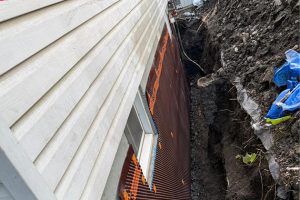
A dry basement relies entirely on drainage that actually works. Over the decades, old clay weeping tile gets crushed, choked with silt, or packed tight with tree roots. We replace these failed systems with modern, fabric-wrapped perforated pipe surrounded by clean washed rock at the footing level. Excavation is required, but it solves water issues right at the source rather than trying to manage water after it has already entered your home.
Get in touch with ArtForm Construction today, and we'll come out to inspect your foundation and give you a straightforward, honest appraisal of what's going on and what it will take to fix it.